University of Pittsburgh
Department of Hispanic Languages and Literatures
Institute for International Studies
Social and Public Policy Conference (2019)
Project: A comparative analysis of Indigenous-oriented education policy in
Mexico and Guatemala
Setting the stage: At the University of Pittsburgh, I specialize in the cultural representation and political participation of Native communities in Mexico. While narrowing the scope of my dissertation, I pulled statistics from Mexico’s reports on national development that demonstrated how badly the educational system was failing its Native inhabitants: despite more investments, greater access, even less Native people were graduating high school than 20 years ago. I saw that Guatemala showed similar data. I performed a comparative analysis between the two systems to identify root causes of system failure.
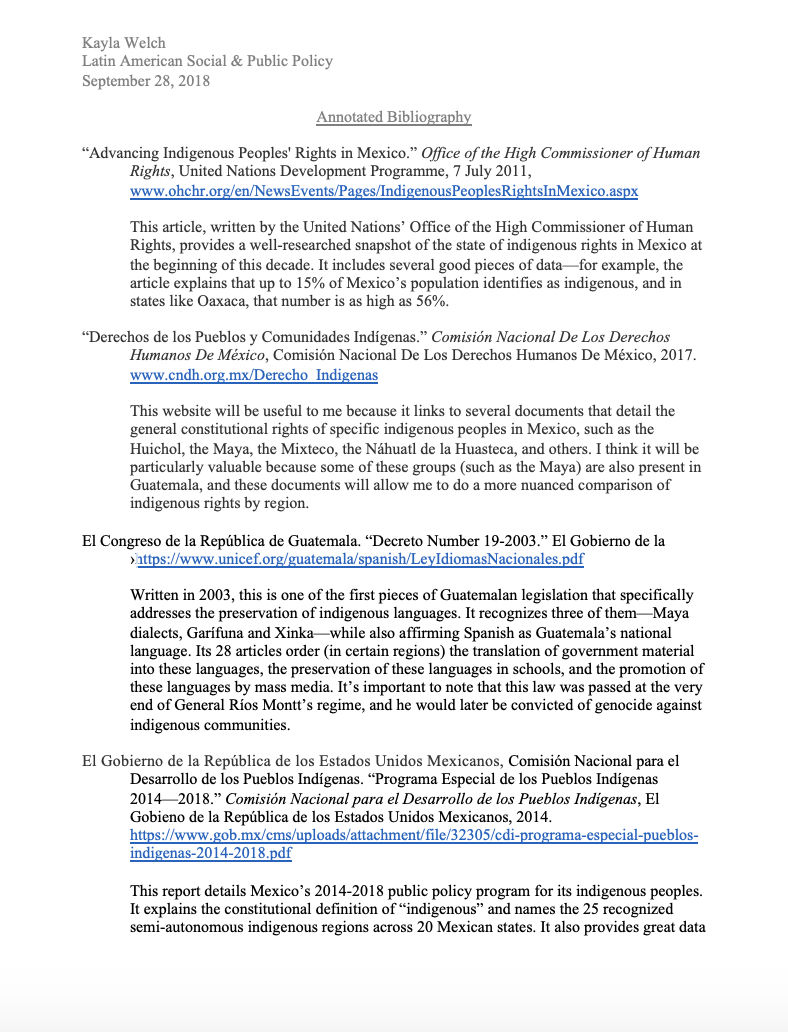
Literature review: I performed a literature review to understand what the academic and policy communities had written on education and Native populations in Mexico and Guatemala. I then created an annotated bibliography of the most useful sources, which included primary material, secondary material, and statistical data published by federal and local governments. My biggest takeaway was that the subject remained largely untouched: I found research that analyzed education systems and research that analyzed Native groups, but not both.
Look at my annotated bibliography to the right.
Scoping: After organizing my data into problem areas, I realized that the research I faced was one of contradiction. Both Mexico and Guatemala had begun the twenty-first century with a focus on the preservation and education of Native communities, but graduation rates and Native linguistic loss were rapidly accelerating.
This was the interesting question: why did similar discourse and similar data not match in both cases?
These congruencies led me to hypothesize that the systematic root cause had to be international. Look below to view Spanish-language visual representations of data that I created in Excel and PowerPoint to allow me to identify data patterns.
school enrollment data of mexican Indigenous population over time
Educational attainment data of guatemala’s indigenous vs. non-indigenous populations
Linguistic, literary, and educational attainment data of mexico’s indigenous population over time
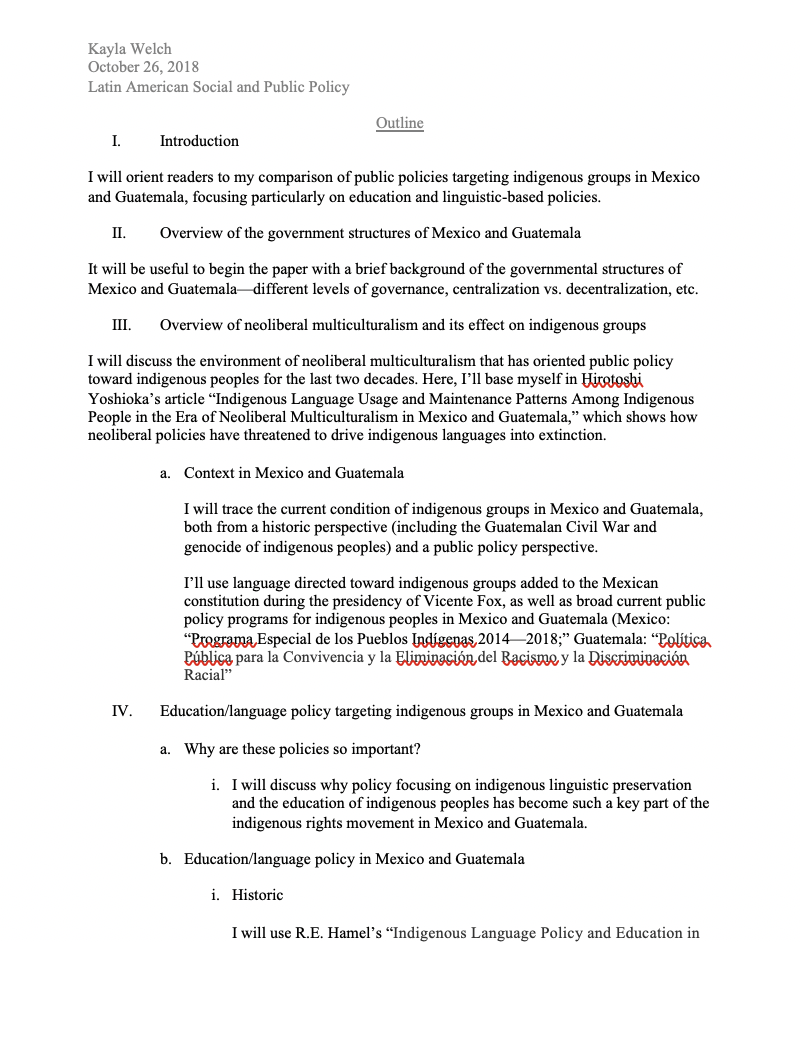
Checkpoints: I had defined my research question to international systematic failures of of Indigenous-oriented education policies. I then analyzed different international actors and forces and discovered that the International Monetary Fund (IMF), the World Bank, and USAID had granted and loaned millions of dollars to both Mexico and Guatemala in the 1990s and early 2000s with the goal of decentralizing education systems, especially in majority-Native areas.
This allowed me to identify the root cause of international systematic failure: international diffusion of neoliberal multiculturalism. You can see the paper outline I created as a checkpoint to the left.
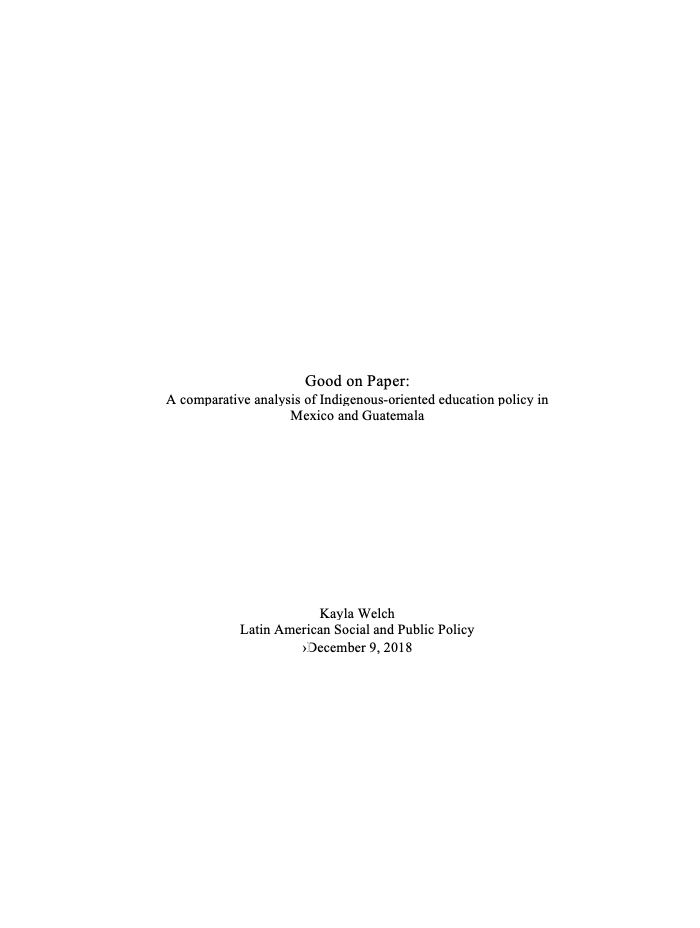
Study: My final study argued that the diffusion of neoliberal multiculturalism and the resultant decentralization of government had systematically failed to improve Native educational outcomes in both Mexico and Guatemala.
I argued that the data revealed six policy improvements to better these outcomes, including the clear definition of policy objectives; the development of wide-scale data gathering initiatives, the teaching of Native languages to all Mexican and Guatemalan students, including non-Native students, and the creation of bridge programs to help Native teachers receive federal teaching certifications.
You can find the study to the right.