
3 strategies for connecting your alumni to a cause
Kids these days.
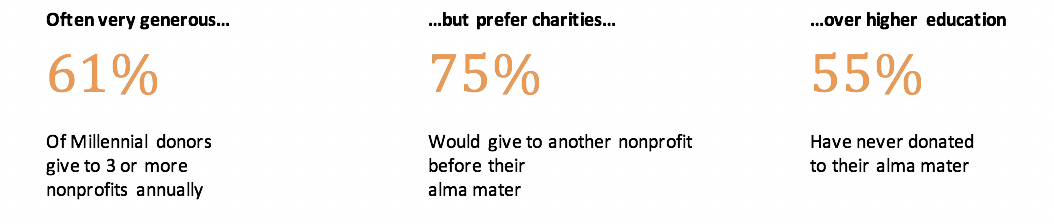
Annual giving directors from private and public institutions of all sizes tell us that millennials have them scratching their heads. A socially conscious generation, they’re quick to open up their wallets for a variety of causes, but also skeptical about giving back to universities. 75% of millennials say that they’d donate to another nonprofit before making a gift to their alma maters.
Why the disconnect? For many young people, it comes down to impact. As a young alumna from Augustana College told us, “It would never cross my mind to give to my school. If I can only give $100, you get to see that go so much farther with a smaller, more localized cause. If you give $100 to a school you might get a thank-you note. It almost feels like giving your money to the mall.”
And we all know what’s happening to malls.
Annual funds can avoid similar fates by capitalizing on this shift in motivation toward cause-based giving. Keep reading to learn three strategies for cultivating young alumni by connecting them to causes they care about.
Millennial alumni skeptical about giving to higher ed
1. Solicit for “common denominator” causes
Donors increasingly want to have a direct impact on beneficiaries’ lives, and too often, solicitations make broad, institutional asks that don’t align with their passion to do so. To solve this problem, advancement staff need to identify gift designations that a large number of alumni find meaningful.
Rather than guess which causes would motivate alumni to give, the Massachusetts Institute of Technology (MIT)—in partnership with Evertrue—analyzed social media engagement data to identify top-performing Facebook posts. MIT found that a student robotics group generated intense enthusiasm from alumni non-donors, and followed up by soliciting all non-donors for a gift to the robotic group’s crowdfunding campaign.
The solicitation brought an additional 90 donors to the project, including one $20,000 gift from a non-donor who had never before taken a visit with MIT.
2. Enfranchise campus partners
Central advancement staff struggle to identify alumni interests, and even if they can link to particular affinities, sending an appeal from the annual giving office probably won’t draw enough attention to inspire action.
That’s why tapping into campus partners’ visibility into the alumni experience is crucial: the resultant messaging and designations align with “hidden affinities” that advancement staff might otherwise overlook.
Under Texas Christian University’s ambassador-driven outreach initiative, a diverse group of campus partners—ranging from a rhinoceros researcher to the school’s director of first year experience—help annual giving staff identify target groups of young alumni and craft meaningful solicitations that appear to come from ambassadors’ personal accounts. Although central staff send the appeal, each solicitation seems customized to individual donor experience.
3. Put donors in the driver’s seat
Ultimately, no one knows what motivates a donor to give better than the donor herself. Alumni need to be able to easily access designated fund information online—and burying that information in annual giving websites can mean potential donors fail to find something they feel passionate about supporting.
Advancement and IT staff can combat this problem by overhauling the institution’s giving page to better guide donors toward a cause that motivates them. User-friendly layouts should present site visitors with cause photos, customized cases for support, progress bars, and other multimedia elements that help sustain momentum through the completion of the gift.
Recently, the University of California, Los Angeles (UCLA) put donors in the driver’s seat by launching a new giving website that allows alumni to browse through a range of funds from all across campus. Instead of traditional drop-down designation lists divided between colleges or schools, UCLA organized its funds by 14 causes that range from the arts to technology. Each fund displays a progress bar that tracks donations, allowing donors to visualize the impact of their gift.
We understand young donors. With one more click, you can too.
Your most recent alumni are often the hardest to engage. Subscribe to our Advancement Blog for updates from our experts to ensure your advancement strategy keeps pace with your youngest alumni.
How to transform millennials into monthly donors
Millennials. There are many claims about this generation—they’ve done everything from kill the movie-going experience to spend retirement money on avocado toast.
Whether these claims are true or not, one thing is clear: it's becoming harder and harder to obtain and count on millennial alumni giving.
The challenge: Turning intentions into gifts
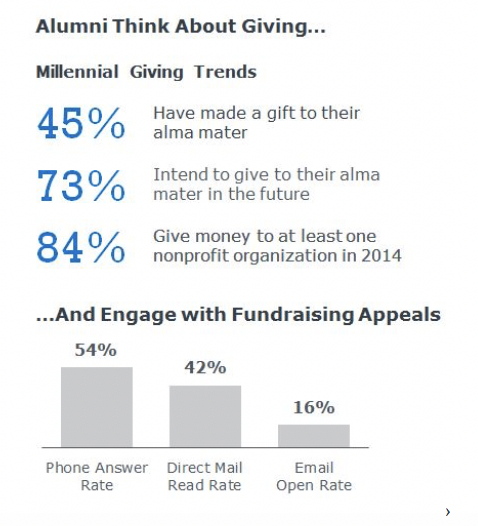
While 73% of millennial donors intend to give to their alma mater in the future, actual giving from millennial donors remains inconsistent. Millennials engage with their alma mater’s fundraising appeals at a similar rate as their older counterparts—but 39% of young donors fail to renew gifts each year.
It’s clear young alumni are consumed by the attention economy. Advancement officers must make giving easier through targeted, monthly campaigns that speak to millennial interests (e.g., convenience, giving to a cause) and giving that is automatically renewed to tackle conversion problems.
Eager and engaged, yet unpredictable, millennial donors create a need for new approach to sustained giving. Our research has revealed several schools who approach sustained millennial giving in new and successful ways.
Frame monthly giving for the millennial mindset
At William & Mary, advancement officials launched a monthly giving campaign specifically for young alumni. The campaign emphasized how monthly giving aligns with millennial’s passions and giving preferences. They highlighted the convenience of monthly giving and underscored that monthly giving is the best way for small-gift donors to collectively create a big impact.
Through these efforts, William & Mary advancement staff increased young alumni donors by 288% from 2014 to 2016. Further, the monthly donor renewal rate averaged 86%, resulting in $468,000 in annual recurring donor revenue. Young alumni recurring donors at William & Mary surpassed their one-time-giving counterparts by the end of the program.
How UT turned a senior class gift into lifelong giving
Advancement staff at the University of Tennessee sought to solve the retention gap in their young alumni giving. Although their senior gift program was extremely successful, very few seniors returned to give after their first year as alumni. By simply adding a "recurring gift" option to their senior gift form, advancement officers were able to increase young alumni giving retention. Fundraisers approach seniors at events and in email solicitations prompting them to join the program and fill out the form.
In 2016, 10% of graduating senior donors opted to sign the recurring gift pledge. As a result, the overall retention rate for the graduating class of 2017 is predicted to increase 7% over the previous year's retention rate.
Four frequent challenges to recurring giving
Although they can be extremely successful, monthly and recurring giving campaigns do not come without challenges of their own. Below are the most common roadblocks (and solutions) for a successful campaign:
1. Credit card expirations can leave the advancement office with inaccurate payment information, resulting in lost gifts.
Solution: Ensure proactive outreach to donors with upcoming expiration for pre-renewal cultivation.
2. Fraud cases can lead to unexpected credit card cancellations.
Solution: Formalize plans for multiple renewal reminders through diverse channels.
3. Donors may become comfortable with a low level of giving.
Solution: Solicit for larger monthly gifts on donation anniversaries.
4. The gift system may be unequipped to handle perpetual, recurring payments.
Solution: Set the default pledge length to exceed credit card expiration date as a technical workaround.
By preventing or solving these common pitfalls, advancement offices can use monthly and recurring giving to not only target—but predict (and keep!) the unpredictable millennial giver.
Russia speaks out about U.S. airstrikes in Syria

Fighters for the Islamic State during a parade in June in Raqqa, Syria.
Source: New York Times
Raqqa Media Center, via Associated Press
Another rough patch emerged this week in the increasingly tense relationship between the United States and Russia. The two nations, which have been at chilly odds over Russia’s destabilization of Ukraine, once again found themselves in dispute: this time, over the conflict in Syria and the United States’ amped-up role in the region. Late Monday evening, the United States launched an aggressive airstrike attack in Syria against the Islamic State of Iraq and Syria (ISIS), a self-declared terrorist group that U.S. forces have been targeting in Iraq since early August.
Russia has also loudly condemned ISIS and offers no resistance to the organization’s elimination. Where Moscow does object, however, is at the lack of cooperation between U.S. forces and the Syrian government.
The Washington Post details how President Obama has refused to coordinate strikes against the terrorist cell with Syrian President Bashar al-Assad. Russia argues that any U.S. airstrike in Syrian territory lacks authority without al-Assad’s go-ahead, and is pushing for solutions to ISIS that count with the leader’s cooperation.
Accordingly, Russian President Vladimir Putin criticized the attacks on Tuesday. His country has long resisted the overthrow of al-Assad, claiming concern over a rising instability in the region. Russian officials fear that U.S. airstrikes will target not only ISIS, but also the Syrian Army as part of an effort to topple Syria’s unpopular government alongside grassroots terrorism.
This means that although Russia is interested in eliminating ISIS, they are wary of working with the United States. Instead, they aim to push the United Nations into confronting the airstrikes and urging dialogue between the U.S. military and the Syrian presidency.
Washington seeks no such coordination with Damascus, since it alleges that the Syrian government has used chemical weapons against its own people. International law requires giving warning before attacking a country, and the United States did notify the Syrian government of the impending strikes before the attacks on Monday. Al-Assad’s reaction to these warnings remains unclear.
Despite equally recognizing the danger posed by ISIS, Russia is certain that unilateral U.S. actions will only further destabilize the region while the United States refuses to extend its alliance to the Syrian regime. Will the two nations be able to synchronize their separate influences in the Middle East and form a coherent assault against regional strongholds held by ISIS? At least for now, such cooperation appears unlikely.
A conversation with Ron Scherer, reporter for the Christian Science Monitor
Ron Scherer is a reporter for the Christian Science Monitor, where he has worked for 36 years. Previously, he worked for U.S. News & World Report and United Press International, and wrote for The Armored Sentinel at the U.S. Army base in Fort Hood, Texas, where he served during the Vietnam War.
Scherer spoke with onPoverty about his favorite poverty-related stories, how the digital age has affected poverty coverage at The Monitor, and what he hopes the future holds for poverty coverage in the media.
What is your beat and how does poverty come into play?
The Christian Science Monitor has changed over the years. We used to be an actual newspaper instead of just a website. My beat at that point was sort of the general economy, maybe some business-type stories and things along that line. Now we’re online all the time, and we produce a weekly publication. For the most part, I’m writing for the daily website and what I’m writing really depends on what the news is. It’s very editor-driven. Editors sit there and look and say, “Oh, this is what we see that’s trending on Google. We need to get a story done on this.”
Sometimes I cover economic issues. One of the stories you may have seen is called “Children of Poverty.” And that was the direct result of a news event that was taking place—the Census Bureau releasing data.
So anyway, it is a varied beat.
I’m really glad that you are doing this and that there is a thing such as onPoverty.org simply because there is just not enough emphasis on the solutions to the issue [of poverty] and getting people aware that the issue exists.
Do you regularly check the information coming out of the Census Bureau, or are there other sources that you turn to regularly for story ideas?
One of my main sources along that line would be NELP—The National Employment Law Project. NELP advocates for people who are out of work and for the unemployed. They are out there with their megaphones, so to speak, saying, “Hey, we have to do something for these people.”
I use them as a source frequently because they are familiar with the legislative battles that are going on with Congress, as well as in the states. Also, they have affiliates all around the country, and they are able to get you in touch with people who are out of work. People who are out of work are not necessarily in poverty, but the odds are that they are.
The other place is the Center for Budget and Policy Priorities, [another] Washington-based organization. They spend a lot of their time looking at the major issues that affect poor people, whether it’s Medicaid, whether it’s SNAP, whether it’s TANF, whatever it might be they are looking at these issues frequently and issuing reports on them. And they’ve got experts that are really useful for our purposes.
The Census Bureau is useful as a resource because they have data like nobody else has, so they’re very good.
Those are the major ones that I can think of that I use.
How big of a priority is poverty coverage for the Christian Science Monitor? Did this change at all when the publication switched from print to web?
The issue is that we don’t have as many reporters on the staff as we used to. We’ve downsized considerably. One of my former colleagues on the staff used to write about social issues, especially poverty issues, from time to time. And we had other people as well.
[With] the type of newspaper that we purport to be, we feel like [we have] an opportunity to educate people by talking about this issue. We’re not The Wall Street Journal, where we’re writing for business. We like to think that we’re bringing a contribution to the world, and alerting people to poverty issues is part of that contribution.
I don’t feel as if the paper has intentionally said we’re not going to cover poverty issues. If we don’t cover enough, and I think you can argue that we don’t cover enough, it’s simply an issue of resources.
Is there a story you’ve written that sticks out in your mind as the best or most important story that deals with a poverty-related issue?
The “Children in Poverty” story I wrote is something that stands out in my memory. I’d seen a 60 Minutes piece on homeless children that was a really powerful piece. As part of that story on children in poverty, I decided to track down the FIT program in Seminole County, Fla., (which was mentioned in the 60 Minutes piece). And this was very useful because [the woman I talked to is] right out there on the leading edge of this—seeing all of the homeless children with their families. I just found that it was very rewarding to touch base, to find out what was happening and what they were doing.
A couple things that stood out: One was that they have something like 1,200 homeless children in Seminole County alone. And the only way they would help people, because they had some money, was if somebody was working, which is kind of mind-boggling to me. So unless one of the male or female heads of household is actually working, that child is going to remain homeless in Seminole County because they won’t help anybody unless they’ve got a job.
The other story that stands out is the declining standards of living story I did. I got in touch with a fair number of people who had lost their jobs. And boy, [when] you’re talking to them it’s really difficult to not say, “Let me write a check to you right now,” because you hear of the dire straits people are in.
I think that probably as a journalist, if you’re going to cover poverty like this it’s really difficult because you meet people who are in such dire straits. You want to be able to reach into your pocket and help them out.
Do you have any advice for other reporters who are trying to cover poverty-related issues?
What’s difficult is the way that the media has changed. Editors are always trying to feed the beast. So there’s increasing pressure to write “x” number of stories per day, and it becomes more and more difficult to actually get out and meet people and write about how they’re living.
I would encourage people to write about poverty because it’s an issue that we need to have more written about and it’s not a popular subject. It’s not like it’s one of Google’s trending topics all of the time, yet it’s something our society needs to be aware of. So I would say to reporters: Go for it. Write more stories about these things.
What do you think the biggest poverty-related issue is in the area that you cover?
Jobs. People with good jobs aren’t poor. So in my mind, that’s the biggest issue: How do we get more jobs for people? And then you get down to: How do we get people more interested in education because if you have a college degree—even in journalism—the unemployment rate is 4 percent. But if you have a high school diploma, the unemployment rate is considerably higher. If you dropped out of high school, then you’re lost. I mean, the whole system is stacked against you. Your odds of having a good job are really slim.
It seems like the coverage of unemployment rates, etc. has decreased recently.
Well, we have a presidential campaign that’s cranking up, so from a journalistic standpoint politics is beginning to become the issue. 2012 is what the editors will want to have out front. Will poverty be a part of the 2012 election? You would like to think it would be. But I have a feeling it won’t be as in the forefront as you and I would like to see it. You haven’t heard any of the candidates discuss poverty. Instead they’re discussing how they think that the tax rates shouldn’t be raised on high-income people and cutting the budget. They want to cut discretionary spending.
And the one thing that I will say is that I suspect the way we are going, unless the economy turns around considerably in the next year or two, poverty rates in America will be rising even more. And there will be less of a safety net.
I think that organizations like onPoverty.org can help say OK, what are some of the solutions? How can we do things that are positive? Because if you just sit there and look at all budget cuts coming down the road and stuff like that, it’s not going to solve the issue.
3 places you can't miss in Bogota
I love the feeling of waking up in a new place. How the sounds bleed in bit by bit—people in the street, unfamiliar cars, the clattering of wheels and feet—until they’re accompanied by smells, feelings, a flash of sunlight through a curtain.
We started our trip in Bogota, a city about which I’ve heard mixed reviews. Some people call it cold or undifferentiated from any other capital city—a little boring or difficult to navigate.
I loved it. The local people were incredibly friendly—keep in mind, I flew in after two years in DC, so my expectations might have been low—and the food was divine. Ajiaco for the win.
Our three days in Bogota included Monserrate, a beautiful mountain that’s crowned by a chapel and offers expansive views of the city, the nearby town of Zipaquirá and its salt cathedrals, and exploring Bogota’s colonial sectors, including La Presidencia, el Congreso, a former-convent-turned-art-museum, and (my favorite) a street filled entirely with book vendors next to the Gabriel García Márquez Cultural Center.
We also checked out La Zona Rosa, which has some very high-end shopping and restaurants. After dark, we were careful to take a secure taxi service, since the number of robberies-by-taxi in Bogotá has been growing. All in all, we felt very safe, although our hostel in the La Candelaria neighborhood encouraged us to go out with a security guard when we wanted pizza late at night.
In addition to the classics (Monserrate, Plaza Bolívar, Museo de Oro), here are three different recommendations from my time in Bogota:
1. Café Magola Buendía: This adorable coffee shop is what dreams of Colombia are made of. Super chill place with super chique decorations and, of course, delicious hot and cold coffee beverages, not to mention aromáticas, sandwiches, and chocolate goodies. It’s next to the popular La Candelaria neighborhood. Free WiFi!
2. Museo Santa Clara: Located one block away from Plaza Bolívar, this museum is a former convent that now houses colonial art and religious relics. It’s very affordable ($3,000COP/person, about $1) and mysterious—nuns were cloistered for life here, and you can still check out the narrow, winding path they took to get to their confessional boxes. The museum also hosts rotating exhibits from a variety of plastics and performative artists.
3. Centro Cultural Gabriel García Márquez: This cultural center was a gift from Mexico to Colombia, which explains the big Mexican flags out front. They sell every book imaginable here and demarcate special sections of Colombian fiction and non-fiction, which, if you have a literati heart like mine, will make you very happy. Local booksellers also set up stalls outside of the center, so you can easily find bargain-priced used books.
Are you going to Bogota? Have you already been? Hit me up with your own recommendations or questions in the comments!